Track 10
Epilogue : That Happy Day
Video coming soon · check back for the official track video

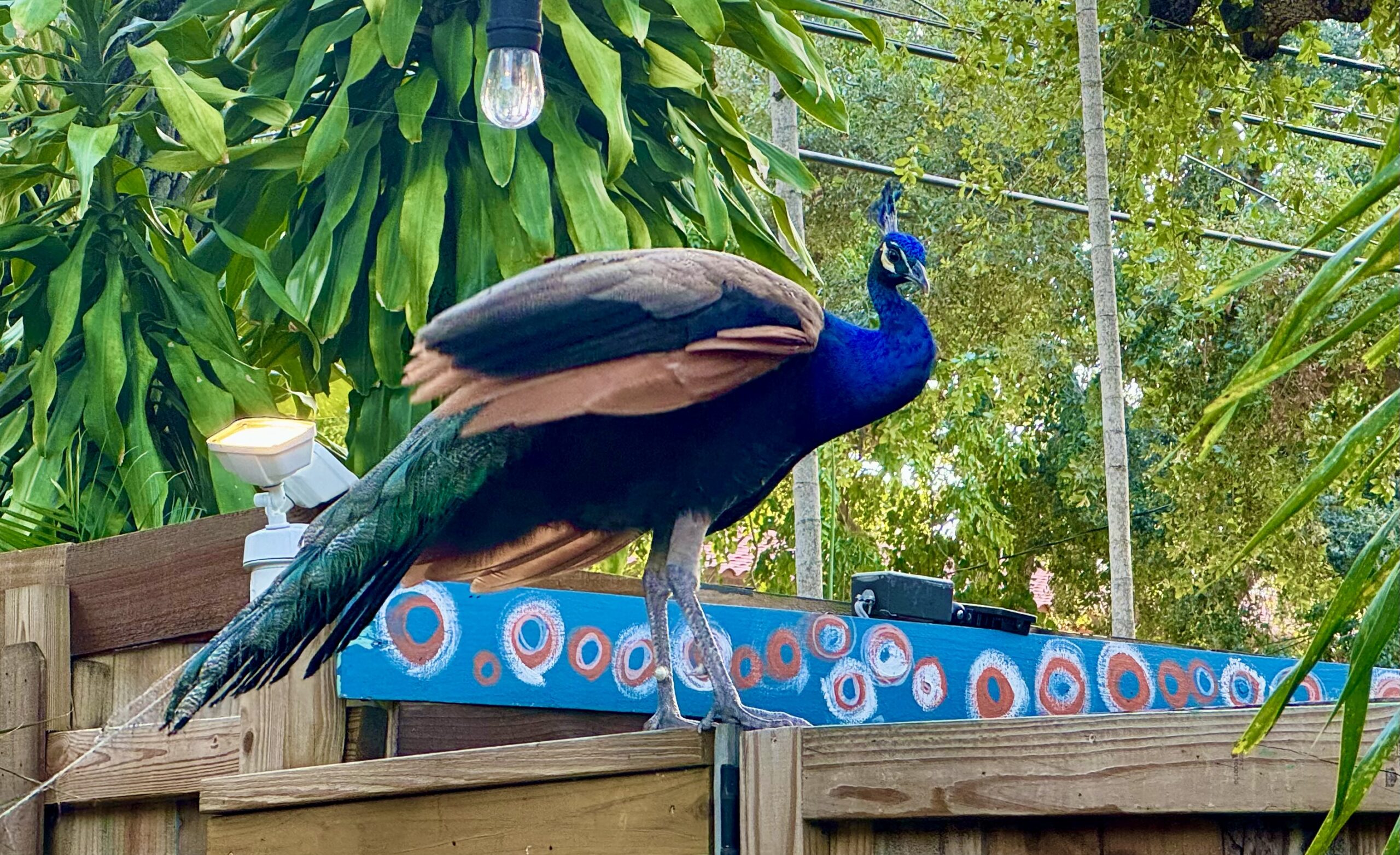
A frequent visitor to my placein the Grove
Its Place in the Story
You see it there on the track list, like a distant oasis — “Epilogue: That Happy Day” — and you think, thank goodness, this poor tortured soul finally finds some peace.
Gotcha.
While the song is called “That Happy Day,” as you can hear, the refrain is “Still waiting for that happy day.” In a way, the joke is on both of us.
To borrow from one of my older songs, this is a song about crying long after crying time is over — long after grief seemingly should have taken its proper place in a closed chapter of your life. But no such luck.
As any grief counselor will tell you, in the same way that you can’t hurry love, you can’t hurry grief. It has its own timetable, its own rules, and its own strange sense of proportion. What one person casts off with a shrug can be a wound that refuses to close for another.
So, what do you do when the grieving has gone on far longer than seems reasonable? Well, first off, as the teachings of mindfulness explain, you don’t blame yourself.
As the poet John O’Donohue writes,
All you can depend on now is that
Sorrow will remain faithful to itself.
More than you, it knows its own way
And will find the right time…
From there, the coping strategies vary. Mostly we just bide our time and try to pay it as little mind as possible, hard as that is. One foot in front of the other, grateful when, once in a while, we “manage a smile.”
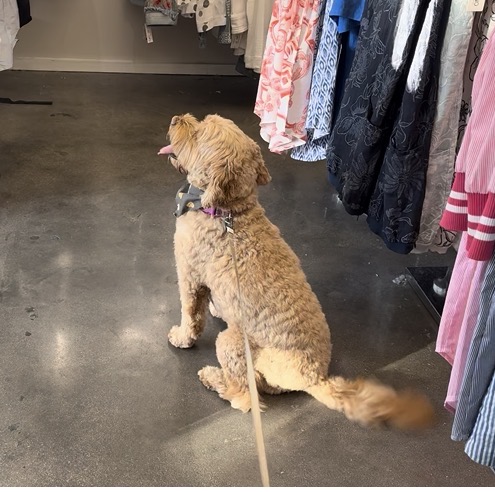
Molly, my constant traveling and songwriting companion. Waiting with uncharacteristic patience for a treat in her favorite Coconut Grove dress shop.
All of this proved to be too much. I began having incredibly vivid, often frightening dreams. The nightmares would leave me waking with a start, disoriented, convinced for a moment that I was back in my bed in Miami. Hence, the song’s title.
Given the vivid dreams, a friend suggested I keep a dream journal and write down whatever I remembered upon waking. I took this on by recording the dreams in pre-coffee stream-of-consciousness prose, without regard for sentence structure, punctuation, or whether it made any sense — just letting it flow.
The nightmares were dark and vivid, filled with ghosts of past failures, missed opportunities, and self-recrimination, mostly shadows and images that seemed, as I wrote in the journal at the time, like the “imaginings of a sordid man.”
About a year later, I stumbled onto a chord progression and melody I liked and decided to try to craft lyrics from the entries in that nearly forgotten dream journal, adding another piece to the narrative that was taking shape. At first, I tried to limit myself to words I wrote in the journal, but eventually found I needed to stray outside it to fill things out. That said, it’s pretty faithful to what I wrote down upon waking.
A Few Words
This is another song I began writing while walking around the neighborhood. The words and melody of the refrain “Still waiting for that happy day” simply popped into my head, and I sang them into my watch. Other melodies and phrases followed, recorded as inconspicuously as possible, my dog Molly’s leash in my right hand, my left wrist close to my mouth.
When I finally sat down with the guitar, I discovered that the melodies I had sung into my watch fit perfectly over the chords of a song I had written in 2015, Everything Breaks Her Heart. In fact, once I started stringing the new phrases together, I realized I could build the entire song — including the middle section — on those same exact chords.
For illustrative purposes, I recently recorded a demo of Everything Breaks Her Heart, which you can hear in the vault below. It’s the first version of the song to feature anything other than my voice and guitar.
The same chords. Two very different songs.
The wonder of music.
As I listened, I suddenly heard how the keyboard line underneath the verses and choruses could swap places with the melody and interlock in an entirely different way. This became the extended middle section where the keyboard figure became the guitar lead over the melody.
Having heard this in my head, I then had to figure out how to create a 20 second gap in the track to drop the new section in. It was a Saturday afternoon. I ended up cancelling my evening plans and spent a good six hours learning how to create the gap and then recording the new harmony and guitar parts. The hours likely felt like minutes, the way time always flew when I worked on a song. You can also hear that first extended version with the new middle section—drums still off– in the vault.
After a long while, I got better at bending Logic’s drummer to my will. The ironic thing is, even though I eventually got it to play in time, I still couldn’t get the feel I wanted using Logic’s drummer. I wanted the track to have a certain spring in its step to match the feeling. For that, I hired a drummer I met of Fiverr. Sadly, I’ve lost his name. It’s the only song on the album that features a real drummer.

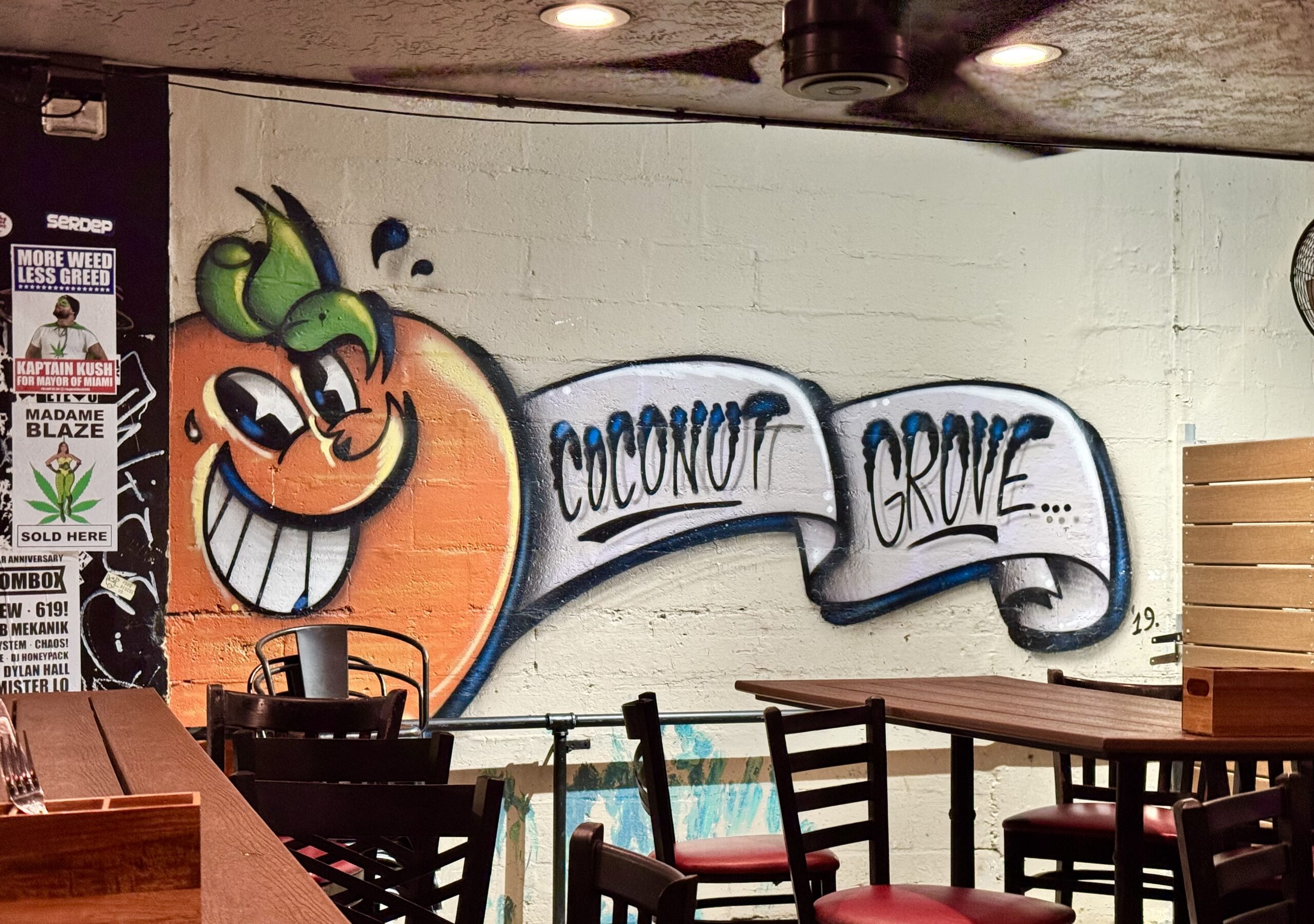
A favorite burger place in the Grove. Formerly an institution, I believe it recently closed because of rising rents.
The Vault
Demos · Alternate Takes · Behind the Curtain
This marks the first time I’d “stolen” the chords from one of my own songs to use in another. Two and a half years into my Logic Pro journey, I was able to bring this song to life fairly quickly. I can’t wait to see what I can do with my own back catalogue.
Early Demo
Original Short Version
An alternative, guitar-driven version. Sometimes I prefer this to the version that made the album. In the end, this stuck me as a bit too rough around the edges.
← Previous · Track 09
River of Secrets
Next · Track 11 →
Postscript