
An album by Michael Cohen

From conception to realization: Turning heartbreak into art.
By Michael Cohen · Notes from the writing room, studio, and everywhere in between
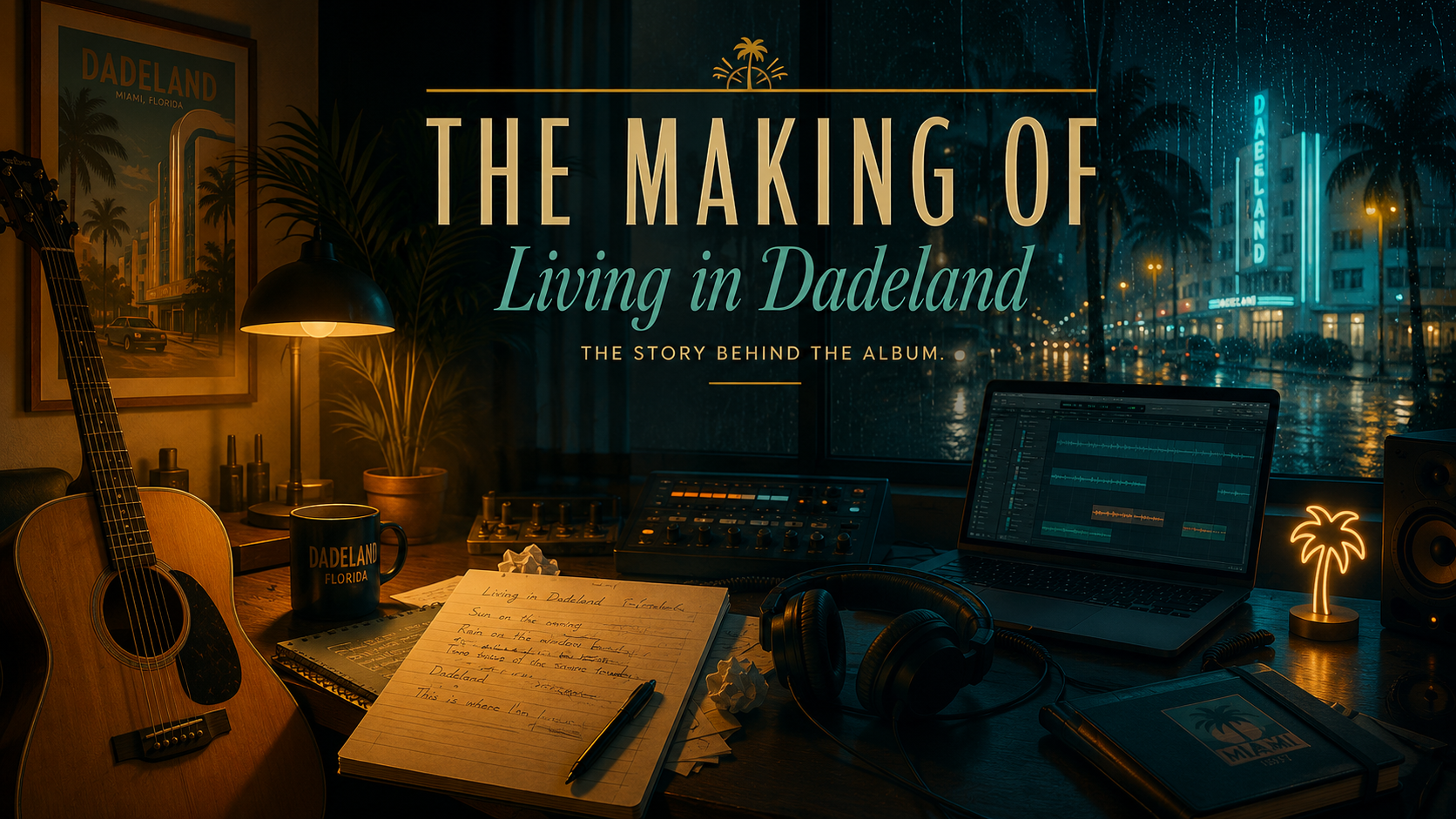
From conception to realization: Turning heartbreak into art.
Thank you for visiting this site and following along with me. My name is Michael Cohen. I’m an attorney, certified mindfulness meditation teacher, and a long-time songwriter.
As a narrative album, Living in Dadeland tells a story. This site shares the narrative within the story — the story of its creation, from a tale of heartbreak I had to tell, to the album I was compelled to make. There was, however, one minor problem: I knew little about music production. So through this site, I’ll share how I taught myself music production, crafted the songs, and built the album from scratch. It was an often frustrating, exhilarating, and ultimately exhausting process that took over two years to complete.
Here you’ll find the entire album to stream. In addition, each track has its own page, with demos, videos, and notes about the creative process. But first, a little more about me and the album.

Those first uncertain days VERY early in the process · teaching myself a bass line · notice the plastic tags still on the keys
My Background
My creative life began early: falling in love with The Beatles at seven, then discovering Leonard Cohen’s poetry at thirteen. I started writing poems soon after and kept going through my teens.
I came to the guitar almost by accident. In my early twenties, someone left a beat-up nylon-string guitar in a group house I was living in. As soon as I could play three chords consecutively, I began writing songs. I wasn’t trying to master the instrument so much as use it as a vehicle to marry words and music.
In my late twenties, I had the immense good fortune of forming a band called The Invoices with several gifted musicians, including the brilliant Bill Williams — who, decades later, arranged and performed on “Gray April Day” for this album. For three years we shared songwriting duties, and I got to hear my songs come alive in the hands of true collaborators. Unfortunately, after the band dissolved, I didn’t perform or collaborate again for decades. I kept strumming. I kept writing. But that was it.
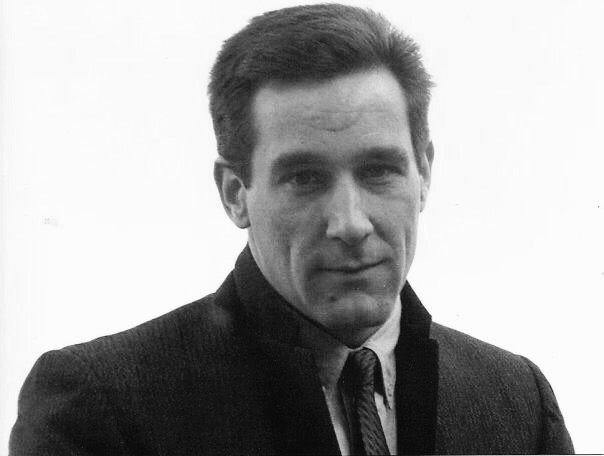
Invoices press kit photo · circa 1989
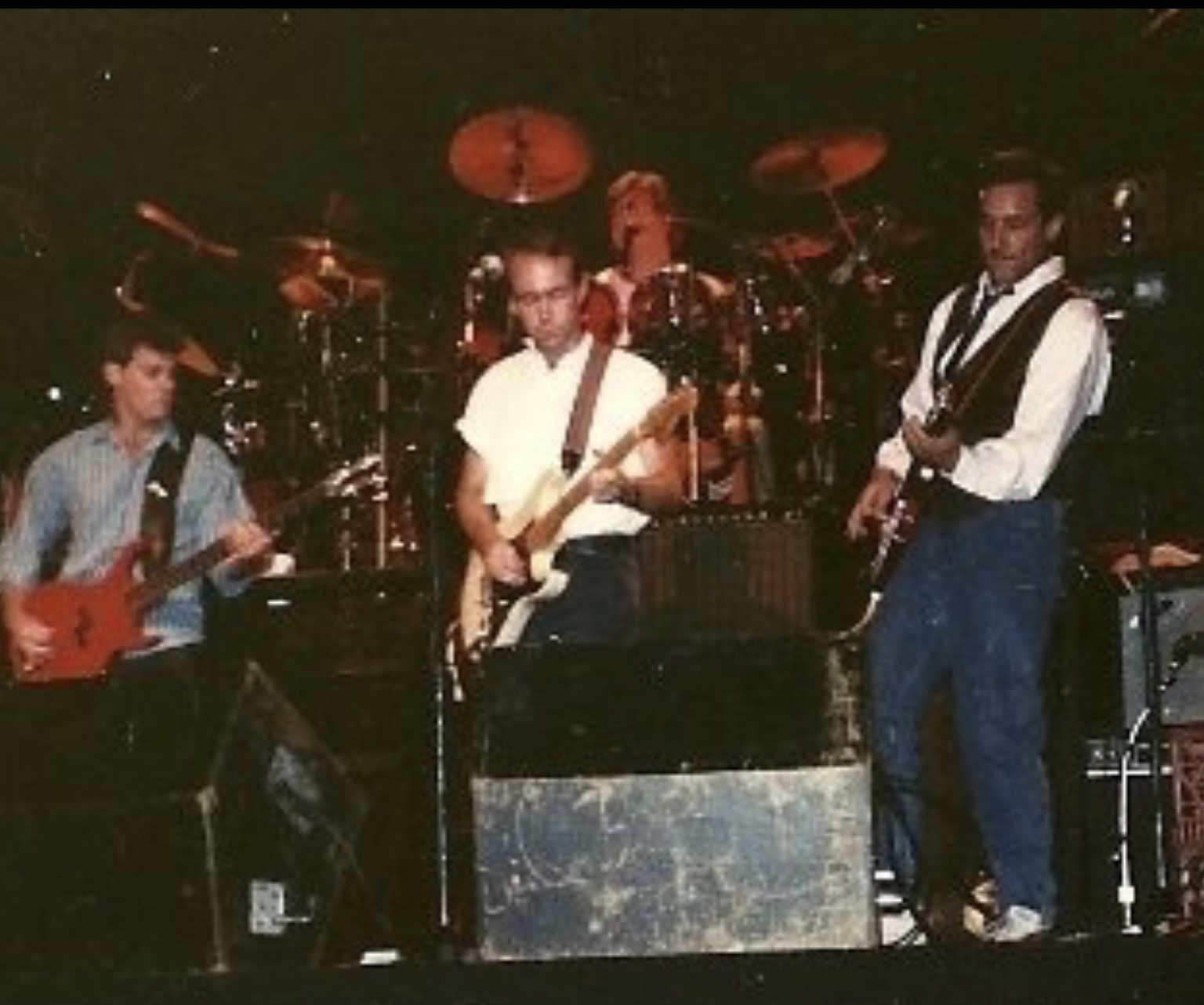
The Invoices performing live · circa 1991 · Bill Williams front and center · the joys of collaboration
The Seeds of the Album
I began writing the first song for the album, “The Other Side of Winter,” in late fall 2021. Fresh out of a relationship and living in a pandemic-era Washington, D.C., I found myself staring down the barrel of a lonely winter. With my office closed, I decided to escape to Miami for a couple of months — a place where I didn’t know a soul.
I began writing “The Other Side of Winter” right before I left, as a kind of farewell to D.C. — a place I loved that somehow seemed to have abandoned me. Once I arrived in Miami — still a stranger in a strange land — I added the line:
"Feeling like I'm at a time in my life I don't know where I fit."
Those first uncertain days VERY early in the process · teaching myself a bass line · notice the plastic tags still on the keys
That feeling turned out to be surprisingly temporary.
Before heading south, a mutual friend introduced me to David Cabrera, a fellow mindfulness teacher in Miami. David is also a Grammy-winning producer and multi-instrumentalist who, as of this writing, serves as musical director and lead guitarist for Jennifer Lopez’s musical revue.
When I sheepishly told David that I, too, wrote songs, he insisted I send him one. So I shared a simple acoustic demo of “The Other Side of Winter,” all that I was capable of mustering at the time. A week later, he sent back a fully arranged version — close to what you hear on the album now. I was blown away. It was something I never could have conjured myself. After decades wandering in the musical wilderness, here was a fully realized version of something I had written. I wanted more.
Love, Loss & Logic Pro
The seed had been planted, but life had other plans. In those early Miami months, an unexpected romance took hold. The joy of that time is captured in “Boyfriend” and the profound sense of safety in “Save My Love Tonight.”
Then, as life sometimes does, everything turned abruptly. That sudden twist of fate shook me to my foundation. Songs poured out of me. I wrote “My Evil Twin” and “Gray April Day” in the immediate aftermath. When I shared “Gray April Day” with my old bandmate Bill Williams, he, too, sent back an arrangement I immediately loved and used on the album.
Feeling shaken and unheard, I had a story to shout from the mountaintop. The songs that came longed for full arrangements, but I had neither a band nor the skills to produce them myself. And the brilliant musicians I knew had full plates of their own projects.
I reached an inevitable conclusion:
If I wanted to tell my story through fully realized songs, I'd have to learn to produce them myself.
The Learning Curve

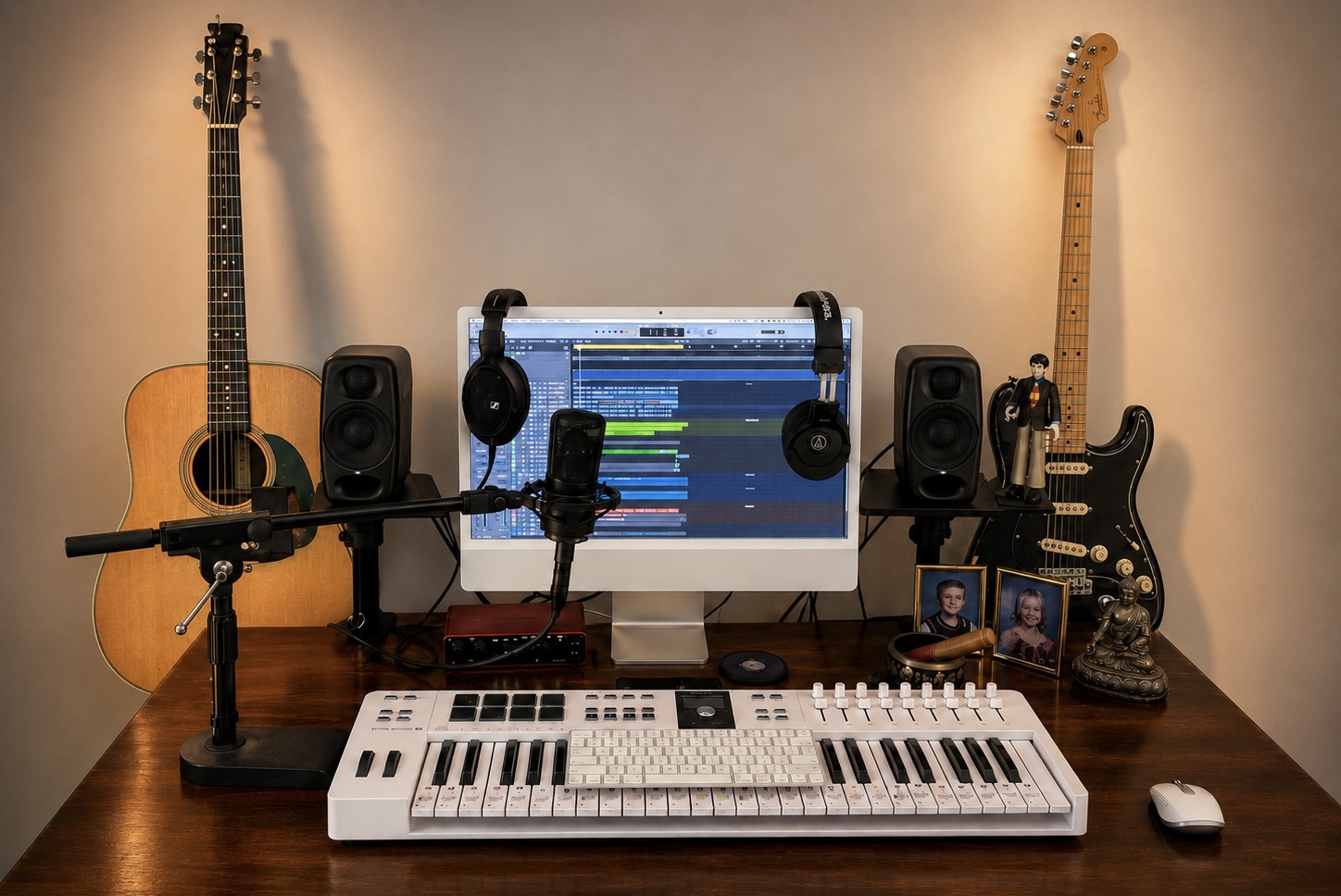
The tools of the trade. Most of my traveling home studio gear. Perched perilously—like the project itself.
I moved around quite a lot during the making of · here's the Baltimore room where I finally got the nerve to record "Nightmare on Franklin Street" · given the song's title, the scary neighborhood felt appropriately unsettling
My breakthrough came by accident. Just when I was about to walk away, I stumbled onto a drum loop that fit “My Evil Twin” perfectly. No fills, no variations, nothing fancy — just the same beat all the way through. But it gave me a foundation. I added bass using the keyboard, then my own guitar, then organ, then vocals. Suddenly, there it was — a full band version of one of my songs that I crafted myself. I must have listened to it thirty times. Finally, after decades of working alone, I had my collaborators. I just had to teach myself to make them play what I wanted.
You can hear that early “breakthrough” version of My Evil Twin on its song page.
From that moment on, I was hooked.
The Story Takes Shape
As I learned the software, the album’s narrative began to clarify itself. Driving through the Dadeland area of Miami — with its sprawling mall, gridlocked traffic, and small apartment complexes — I wondered what life might have been like for the woman I had met when she first moved there after a long marriage. The melody of the song’s opening lines just came to me and I sang it into my Apple Watch. That snippet of melody and musings became “Prelude South: Living in Dadeland,” told from her perspective.
“Prelude North: The Other Side of Winter” tells mine.
From there, the album follows the arc of the relationship — its warmth, its unraveling, its aftermath, and the long slow work of reflection and healing:
Throughout the process, I felt a kind of creative electricity. I woke up eager to work. There were days when everything else felt like a distraction. I rode the waves — from triumph to setback and back again — until I could finally step away and say, “That’s enough now.“
The Healing Journey
In mindfulness circles, we often speak of “the healing journey” — the process of confronting our wounds as a way of transforming and integrating them into a place resembling grace.
Producing this album seemed like a logical part of one’s healing journey, but I have my doubts. Working the songs with the single minded devotion I brought to the project required listening to every track dozens of times as I mixed and refined the songs over time. Practically speaking, it put me in a repetitive cycle of listening to recordings of some of the most painful experiences of my life over and over agin. As I pressed on, I often wondered whether the process was helping or hurting. I’m still not sure. But I am sure that there’s something incredibly life affirming and uplifting about turning your darkest moments into something you can step back from and appreciate artistically. So while making the album may have slowed the healing process, I believe I’m in a better place than if I had let things take their natural course.
"When someone breaks your heart, make art."
— attributed to Jean-Paul Sartre
I suppose that’s the essence of what I did.
Credits & Collaborators
Not long after I began making the album, I discovered that there are online platforms where musicians, singers, and recording engineers offer their services — sites like Fiverr and SoundBetter. My experience working with musicians through these platforms was generally very good. My experience finding engineering help was more mixed, which is one reason I ultimately ended up mixing the album myself.
Through Fiverr, I found the wonderful Olya Gram, who lent her beautiful voice to “Save My Love Tonight.” I also found Riccardo Mazzaglia, who added guitar parts throughout the album, most notably on “My Evil Twin.” Fiverr is also where I found Peter Voronov who contributed viola and violin to Prelude South: Living in Dadeland, along with another track that might be hidden somewhere on this site. Perhaps the biggest coup was finding Alan Douches, who served as mastering engineer for the entire album. As someone who has worked with major artists, Alan brought a level of experience and refinement to the project that I could not have achieved on my own. Just as importantly, he treated me — and the music — with extraordinary patience, care, and kindness.
Then there were the contributions of friends. Randy Byrnes added piano and organ to “Save My Love Tonight.” Bill Williams and David Cabrera each took one of my acoustic demos and turned it into a full arrangement — Bill with “Gray April Day,” and David with “Prelude North: The Other Side of Winter.” Their generosity and musical imagination helped shape the album in ways I could never have managed alone. Beyond that, it inspired me to create the rest of the album.
The Final Push: January to April 2026
I first planned to release the album in the form of rough demos back in the fall of 2024. But as I learned more about music production and began making different choices, I found myself chasing higher levels of aesthetic quality. Higher production values.
That chase continued for a year and a half.
I actually submitted the album for release in early December 2025. I remember feeling more relieved than excited at the time. I wanted my life back. The project had taken up so much mental and emotional real estate, not to mention my nights and weekends. Looking back, the lack of excitement should have told me something.
Because of a naming issue involving “Prelude South: Living in Dadeland,” however, I ended up pulling the album before release. I’m so glad I did.
While I waited for Spotify and the other services to sort out the naming issue, I listened to the album with slightly fresher ears and realized that “River of Secrets” was cluttered with too much low-mid energy. The vocal kept getting lost in that murky river. What I thought would be an easy fix turned into a two-month odyssey of experimentation with different arrangements and instrumentation.
Rather than drive myself batty working on one song, I also took the opportunity to make significant changes to both Preludes and to “My Evil Twin.” Just as important, I connected with a new mastering engineer, Alan Douches, whose skill and patience elevated the entire project.
By the end of that final push—and I crammed a lot of work into those few months—the album was finally complete. And not just because I needed to move on with my life, but because, to a greater or lesser extent, all the tracks had finally come close to what I had been hearing in my head.
I could still be working away on all of it. But other songs and endeavors await.
A Message on Creativity
My hope in sharing all this is twofold.
First, to offer a window into the messy, exhilarating process of learning to make an album from scratch. The acoustic demos reveal the genius of David and Bill—their ability to hear a finished arrangement before it exists, plucking it almost out of the ether. Other demos show how songs evolved over time. There’s even one song that was too painful to include on the album. You’ll find it on this site though as a secret, hiding-in-plain-sight track.
Second, I’d like to encourage others to follow their creative impulses. As a mindfulness meditation teacher, I meet many creative souls who are afraid to make things—afraid of judgment, afraid of imperfection, afraid of being seen. The truth is, I share the same fears.
As I’m about to publish the entirety of this project, I’m keenly aware of how personal — and at times dark — some of it is. I worry that it might make people feel uncomfortable or that my students might think less of me for my struggles.
Anaïs Nin wrote, “Life shrinks or expands in proportion to one’s courage.” I’ve often shared those words with students. I suppose if I’m going to talk the talk, I’d better walk the walk. So I’m pressing forward despite the fear, and the very personal nature of some of what appears here. In a real way, I’m putting Nin’s beautiful maxim to the test.
Ultimately, the message is simple:
And in the End…
I continue to wonder why a person at my stage of life would put so much time and energy into a project of this kind.
The first and simplest answer is love of music, which has always been my greatest passion. I found nailing a song or a mix truly exhilarating.
Second, I suppose the lawyer in me had a case to make, and the poet in me had a story to tell, even if, in the end, I wasn’t sure who would listen.
Then again, the poet Mary Oliver writes:
Someone I loved
once gave me
a box full of
darkness.
It took me years
to understand
that this, too,
was a gift.
Perhaps the whole process was my way of looking for the gift in the darkness.
I’m still looking.
What I have found, though, is the most absorbing creative pursuit of my life. In the end, that’s not a bad consolation prize.
After all — to mix Eminem and Mary Oliver — we only get one shot at our wild and precious life.
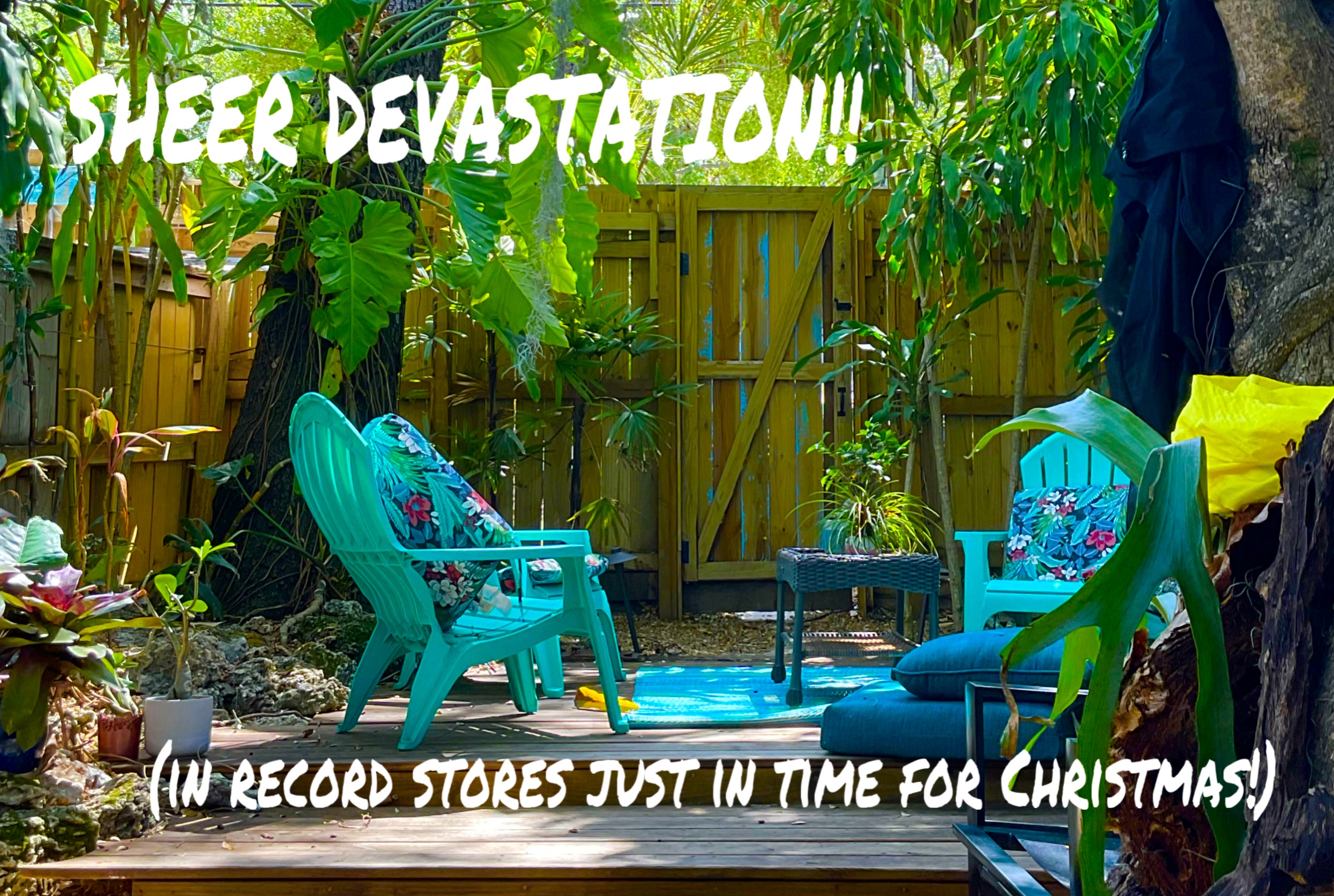
An early album cover concept · thankfully, cooler heads prevailed
Michael
Washington · Miami
Inside the Songs
Released
Track 01
Prelude South
Track 04
Save My Love Tonight
Track 09
River of Secrets
Coming Soon